Join a committee
Committees
Committees and task forces include overseeing multiple projects that their members are leading and helping their members to find meaningful and prudent projects for the Undergraduate Student Government to be working on. This may range from scheduling meetings with administration to conducting research on advocacy issues or conducting programming to support advocacy initiatives. Read below to learn more about each committee.
What committes are there?
-
The Diversity and Inclusion Committee aims to promote diversity, equity, and inclusion within all facets of student government and throughout the University’s campus. DEI work to address diversity issues across the campus, ranging from assessing the quality of prayer spaces on campus to advocating for the expansion of BIPOC-focused academic programs across the University’s colleges. Contact salad076@umn.edu to learn more and join!
-
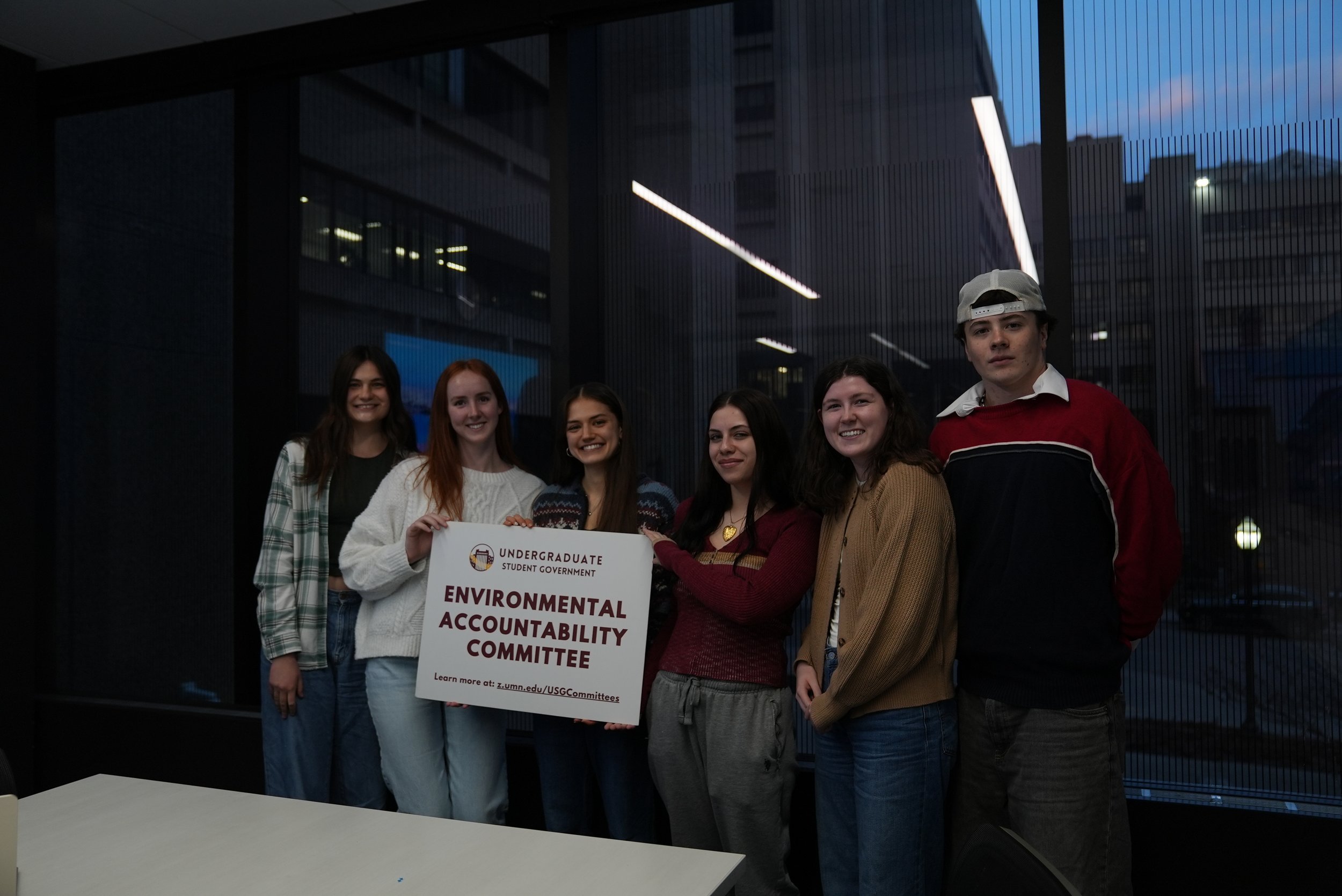
The Environmental Accountability Committee is responsible for USG initiatives regarding environmental and energy issues. The committee works to increase and maintain student representation in University decision-making regarding environmental issues and advocate for the addition and expansion of environmental programs on campus. Contact werde019@umn.edu to learn more and join!
-
The Infrastructure Committee’s mission is to advocate for and contribute to the improvement of infrastructure on campus. The committee works to ensure that campus transportation, buildings, roadways, and walkways are safe, efficient, and accessible for all students. It seeks to educate students about the existing infrastructure on campus by sharing information on how they can best use the transportation, buildings, roadways, and walkways on campus. Contact kidwe017@umn.edu to learn more and join!
-
The Student Life & Wellbeing Committee aims to support and advocate for students' wellbeing around the University of Minnesota campus. Campus Life not only wants to create a more accessible way for students to find clubs and resources, but also maintain and develop a support system while students are learning the ropes of the University of Minnesota. Contact abdiw105@umn.edu to learn more and join!
-
The Public Health & Prevention Specialized Committee amplifies the voices of victims and survivors and those historically excluded from the conversation. Together, they fight to create a campus where there is zero tolerance for sexual assault and host self-defense workshops, safety panels, and fundraise for the Aurora Center for Advocacy and Education. Contact sheri252@umn.edu to learn more and join!
-
The Technology & Digital Innovation Specialized Committee is a new committee that aims to advocate for the students’ technology needs and preferences! You’ll have the opportunity to collaborate with other students, faculty, staff, and administrators on developing new technology solutions that can enhance our student and academic experience. Contact belin040@umn.edu to learn more and join!
Meet Committee Staff
-
![]()
Lily Kidwell
Committee Director, Infrastructure kidwe017@umn.edu
-
![]()
Layla Salad
Committee Director, Diversity, Equity & Inclusion salad076@umn.edu
-
![]()
Mia Werden
Committee Director, Environmental Accountability werde019@umn.edu
-
![]()
Zahwia Abdiwahab
Committee Director, Student Life & Wellbeing abdiw105@umn.edu
-
![]()
Hanan Sherif
Chair - Public Health & Prevention Specialized Committee sheri252@umn.edu
-
![]()
Benni Belina
Chair - Tech & Digital Innovation Specialized Committee belin040@umn.edu